
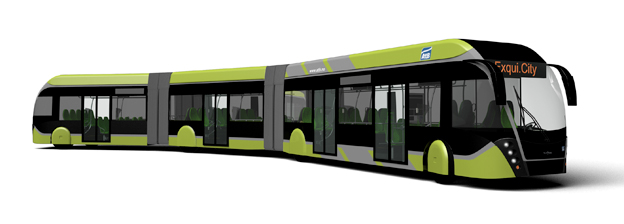
When Super Buses Become Parts Donors: Could Trondheim Be the Next City to Face a Bus Crisis?
Super buses are supposed to form the backbone of future public transport. In Malmö, however, technical problems and a shortage of spare parts have resulted in expensive, high-tech buses being used as sources of spare parts. Trondheim should now be asking itself an important question: How vulnerable is our Metrobus system?
They were meant to represent the future of public transport. Long, modern and environmentally friendly super buses were designed to carry large numbers of passengers efficiently through urban areas. But in Malmö, this vision of the future has run into serious difficulties.
Several of Malmö’s long, green super buses are now out of service. Instead of carrying passengers, some are being used as donors to provide spare parts for other buses in the fleet.
The background to the problem is the bankruptcy of the Dutch bus manufacturer Van Hool in 2024. When the manufacturer disappeared, access to specialised spare parts became increasingly difficult. This particularly affects buses with advanced technology and components that cannot easily be replaced with standard parts.
The result is remarkable: buses that cost millions of kroner have to be dismantled so that other buses of the same type can remain in operation.
This is more than just a story about technical problems in Sweden. It is a reminder of how vulnerable public transport can become when large parts of the service depend on specialised vehicles from a single manufacturer.
Trondheim faces a similar challenge
What makes this particularly interesting is that Trondheim does not have to look far to find a similar situation. The city has chosen many of the same technological solutions as Malmö.
When Trondheim introduced its Metrobus system in 2019, it acquired 24-metre double-articulated buses from Van Hool. The buses are of the ExquiCity type, the same model family used in Malmö. Trondheim has operated 58 of these buses. They have become the signature vehicles of the city’s Metrobus system.
This means the problem is not merely theoretical.
When Van Hool went bankrupt, the maintenance and service agreement for Trondheim’s buses was also lost. According to AtB’s own assessment, this has resulted in a substantial increase in maintenance costs. AtB warns that maintaining the existing buses beyond 2029 is likely to involve high costs.
This is a serious warning sign.
For Trondheim, Metrobus is more than just a collection of extra-long buses. The entire public transport system is built around three high-frequency metro routes. The buses are intended to provide high passenger capacity, rapid boarding and alighting, and an alternative to rail-based public transport.
The existing 24-metre buses have an estimated operational capacity of approximately 128 passengers. By comparison, a conventional 18-metre articulated bus can carry around 100 passengers.
Replacing the super buses with conventional articulated buses is therefore not necessarily a straightforward solution. It could mean less capacity, greater pressure during rush hour and a need for more frequent departures.
AtB has already identified the problem
In its assessment of public transport services from 2029 onwards, AtB describes the challenges quite clearly.
There is uncertainty about how many of the existing 24-metre buses will have sufficient remaining service life after 2029. At the same time, the market for new buses of this size is limited.
AtB points out that there are only between one and four potential suppliers of electric 24-metre buses, and that only one is known with certainty to be able to supply a suitable model. There is also uncertainty about how well this model would perform under Trondheim’s operating conditions.
The alternative is 18-metre articulated buses. These are much easier to source, but have lower passenger capacity.
Nevertheless, AtB recommends continuing to use 24-metre buses on the metro routes, precisely because of their capacity.
This leaves Trondheim facing a difficult choice: Should it stick with a concept that requires specially built buses from a limited supplier market, or should it make the system more flexible and less dependent on a particular type of vehicle?
Could Trondheim end up in the same situation as Malmö?
Yes, the risk is real. This does not mean that Trondheim will necessarily experience exactly the same problems as Malmö, but the underlying challenges are very similar.
When a public transport system is designed around 24-metre double-articulated buses, replacing them becomes more difficult if problems arise with production, spare parts or maintenance. This is precisely the vulnerability Malmö is now experiencing.
Van Hool’s bankruptcy does not only affect the buses in Malmö. Trondheim also operates buses from the same manufacturer. AtB has documented that the loss of the service agreement has increased maintenance costs.
In addition, there are very few suppliers of electric buses in the 24-metre category. If a supplier encounters production problems, or a new bus model proves unsuitable for Norwegian operating conditions, Trondheim could face difficulties renewing its fleet.
Trondheim has already had to supplement its metro routes with electric 18-metre articulated buses. From March 2025, these buses were introduced on selected services, partly because of delivery challenges affecting the Metrobus fleet.
Don’t let super buses become a technological dead end
Malmö was supposed to be a role model for Trondheim. Politicians and public transport professionals travelled there to study how high capacity, long buses and efficient infrastructure could deliver better public transport.
These experiences helped inspire the Metrobus system in Trondheim. Now it may be Trondheim’s turn to learn from Malmö – this time from what went wrong.
It is a paradox that buses designed to represent the future of public transport risk being left idle because their manufacturer can no longer supply the necessary spare parts.
Trondheim has not, as far as is documented, experienced the same situation of buses being dismantled to keep others running. However, AtB’s own assessment shows that the city has already faced increased maintenance costs following Van Hool’s bankruptcy, and that the future availability of 24-metre buses is uncertain.
This should have consequences for how AtB and Trøndelag County Council plan the future of public transport. The issue is not necessarily about abandoning the super bus concept, but about ensuring that the public transport system does not become dependent on technology that may prove difficult to maintain.
Stricter requirements must be imposed on spare parts availability, maintenance agreements and delivery reliability. Future bus procurement should also consider greater standardisation of components and the involvement of multiple suppliers. Above all, there must be a plan for maintaining capacity on the metro routes if large numbers of the long buses have to be taken out of service.
The most important lesson is that a public transport system must remain resilient even when its technology fails.
A super bus is not particularly super when it is sitting in a depot waiting for spare parts. And a metro route is not a viable alternative to the car if passengers cannot rely on the buses actually turning up.
Trondheim must therefore ensure that its ambition to provide high-capacity public transport does not become a technological commitment that makes the system more vulnerable.
The super bus of the future must not only be long, modern and environmentally friendly. It must also be possible to maintain it – throughout its entire service life.