
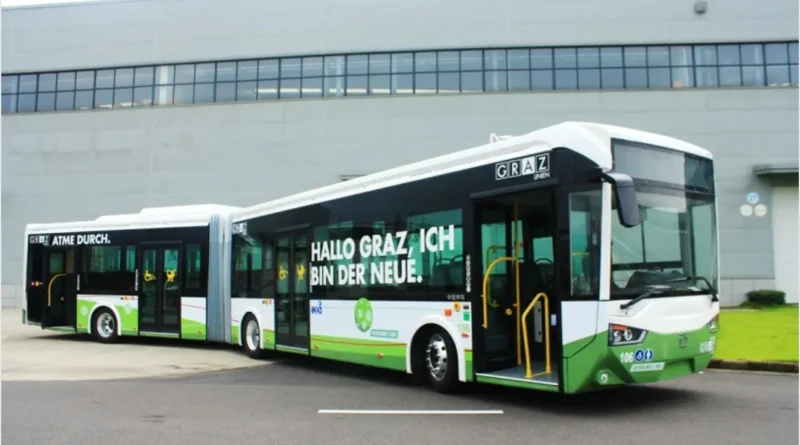
CRRC and YES-EU to Start Bus Production in Italy in 2028
The former Maserati factory in Grugliasco, near Turin, is set for a new lease of life. Swiss mobility company YES-EU has signed a preliminary agreement to acquire the former automotive manufacturing site, with plans to begin producing electric buses, minibuses and battery systems from 2028.
The former Maserati plant in Grugliasco, in Italy’s Piedmont region, could become a new industrial hub for electric public transport in Europe. YES-EU has entered into a preliminary agreement to acquire the factory, which covers a total area of approximately 230,000 square metres.
The plan is to establish production of electric buses and minibuses, alongside battery packs, energy storage systems and services related to battery maintenance and recycling.
The first production lines are scheduled to become operational in 2028. The factory is expected to undergo conversion and adaptation throughout 2027.
Once fully operational, the facility could employ up to 150 people.
CRRC Technology Meets European Manufacturing
YES-EU already has an established presence in the European electric bus market and cooperates with Chinese manufacturer CRRC, one of the world’s largest producers of railway rolling stock and electric transport solutions.
Several of the buses marketed by YES-EU under its own brand are manufactured by CRRC in China.
The establishment of production facilities in Italy will give the company an opportunity to expand its industrial presence in Europe. Local manufacturing and assembly could become an important competitive advantage in a market where public transport operators are increasingly demanding electric buses and a stronger European industrial footprint.
Details regarding the specific bus models to be produced in Grugliasco have not yet been announced. Nor has it been confirmed how much of the operation will involve complete vehicle manufacturing compared with the assembly of components and platforms supplied by CRRC.
From Maserati to Electric Buses
The factory has a long industrial history. The site was originally established by Italian coachbuilder Bertone in 1959 and was later taken over by the Fiat Group.
During its Maserati years, the plant produced models including the Ghibli and Quattroporte. The facility was an important part of Italy’s luxury car manufacturing industry and employed approximately 1,400 people at its peak.
After car production was relocated to Mirafiori in Turin, the factory was left without its former core activity.
YES-EU’s plans therefore represent a significant transformation of a historic Italian industrial site – from luxury cars to electric public transport and energy storage.
Batteries and Energy Storage as Key Elements of the Investment
The project is about more than buses.
YES-EU also plans to establish activities involving battery packs, Battery Energy Storage Systems (BESS), technical services and recycling.
This could give the factory a broader role in Europe’s electric mobility sector. Batteries and energy storage are becoming increasingly important for bus operators, particularly in relation to vehicle operations, charging infrastructure and energy management at bus depots.
The company already has experience in battery services through its European cooperation with NING Service, CATL’s official aftermarket brand.
Strategic Investment in the European Bus Market
For YES-EU and CRRC, the Italian project could represent an important step towards strengthening their position in Europe.
The electric bus market is characterised by strong competition between European, Asian and international manufacturers. A local industrial presence could become increasingly important in public procurement tenders, where delivery reliability, service networks, spare parts availability and long-term support are key considerations.
Italy can also offer a strong industrial skills base, established supply chains and proximity to several major European bus markets.
YES-EU operates in approximately 15 European countries and already has a presence in the Nordic market. A manufacturing base in Italy could therefore become an important addition to the company’s existing distribution and service operations.
A New Industrial Future for Grugliasco
The acquisition agreement remains preliminary, and several details regarding investments, production capacity, vehicle models and the supplier structure have yet to be confirmed.
Nevertheless, the plans point towards an interesting development for both the Turin region and the European bus industry.
If the timeline is maintained, the former Maserati factory could begin a new chapter in 2028 – this time as a production and competence centre for electric buses, batteries and energy storage solutions.
From Maserati to electric buses: Grugliasco could become a new European hub for electric public transport.